Chloé Gregg
"I’m more sure of my choice because I tested the alternative"
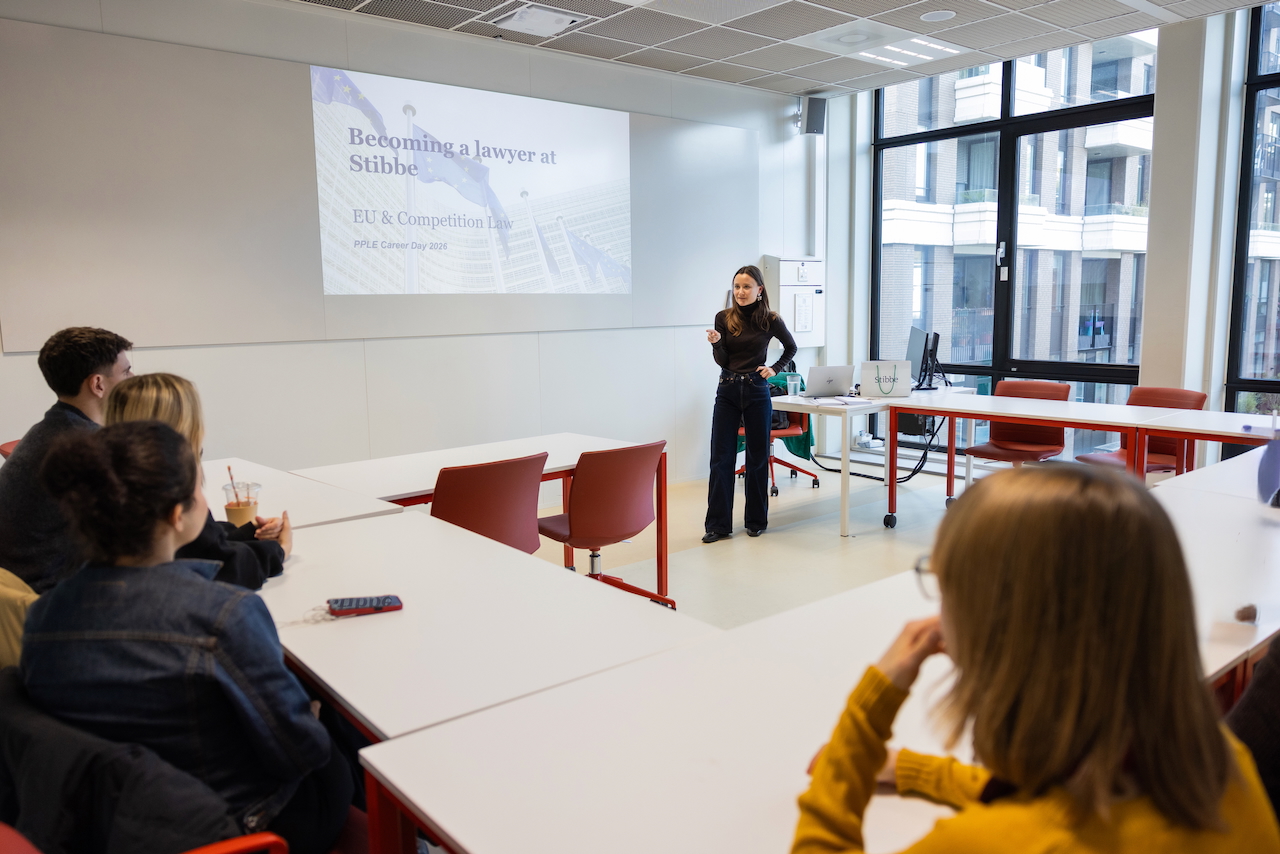
You were back at PPLE recently for Career Day. What did being on campus again bring back to you about your own student time?
A bit of nostalgia, to be honest. I have very fond memories of my time as a student, and I now understand what people mean when they say those are some of the best years of your life. Not that I’m not happy now — I am — but I still look back on PPLE very warmly.
A big part of that is the people. Because the programme is so small, you really get to know one another over those three years. The connections I made there are still part of my life today. They were strong bonds, and they shaped who I became.
PPLE also exposed me to people from all over the world in a way I would never have experienced if I had stayed in France to study. That gave me a kind of flexibility and adaptability that still helps me now, in work and in life. Going back to campus, I could still feel that PPLE identity. The students struck me as curious, ambitious, and thoughtful about what they want to contribute. It was nice to see that spirit is still there.
Before we zoom in on your current work: can you take us through your path after PPLE?
It was a very PPLE path in the sense that it was not linear. After graduating, I was quite set on becoming a lawyer. I went back to France and did an additional year in law to get the right equivalence, but that experience was shockingly different from PPLE: a cohort of around 2,000 students, lecturers speaking into microphones in enormous halls without slides, tutorials of 45 people where no one participated, and almost no real connection with professors. That really made me question both the educational environment and whether I actually wanted to pursue law in that form.
So I took a step back and decided to explore something else. I ended up doing an internship in politics in Paris, working for the mayor of one of the city’s districts. I was helping prepare interviews, speeches, and responses to citizens, and got to see how political communication works up close.
I enjoyed it, but it also made me realise that politics can be very performative. I found myself wanting something more concrete, work where I could see the substance of the issue more clearly, and the effect of what you do. That brought me back to law, but in a different way and with a different perspective.
What made you feel that law was still the right place for you?
When I returned to law, I ended up specialising more in European and competition law. That was the moment things started to click. I liked that it had an international dimension, and I liked the connection to economics — not in a heavily mathematical sense, but in the sense of understanding how markets work, how companies behave, and what happens when power becomes too concentrated.
That was when I felt: this is my niche.
Looking back, I’m glad I didn’t rush straight through. Trying something else helped me understand my own preferences better.
You’ve said that your path has been longer than the more straightforward Dutch route into law. How do you look at that now?
I am currently in the process of qualifying as a lawyer in addition to my job - but it has definitely been a longer path. Some of my Dutch colleagues followed a much more direct route: law school, firm, qualification. Mine involved more ‘trial and error’. I took the bar in France, I failed it, I moved back to the Netherlands, and I’ve had to navigate different systems along the way.
But I’m still very happy I went through those experiences. I learned a lot, lived in different places, and had to question my choices more consciously. I’m more sure of my choice because I tested the alternative. And maybe I’ve also had more fun along the way.
For people outside law: what does your work actually look like?
I work in competition law, and in some ways it can feel a bit like detective work. Companies often come to us when there is already a serious issue — for example, if a competition authority suspects cartel behaviour or abuse of a dominant market position.
A lot of the work involves understanding what has happened inside a company: reviewing emails, messages, presentations, and other documents, interviewing people, assessing risks, and building legal arguments from that.
That’s one of the things I enjoy most about it. You really have to dive into how a company functions, how people behave, and how decisions are made. It’s analytical, but also very human.
What did PPLE give you that still helps in your work now?
A lot, actually. Analytical skills, definitely. Writing too — we wrote a lot at PPLE, and that’s incredibly useful in legal practice.
Most importantly, PPLE taught me how to get comfortable entering new worlds. In my work, every case is different: I have to understand a new market, company, or system and make sense of unfamiliar material quickly.
Because PPLE trains you to think across disciplines and switch between different ways of looking at a problem, it makes you more adaptable. For me, that has been one of the most valuable things.
There is a lot of discussion right now about AI and the future of legal work. What are you actually seeing in practice?
We talk about AI all the time. We are already using it for repetitive tasks that used to take a lot of junior time. In merger control, for example, it can help with checking notification thresholds across different countries.
But you still have to understand what the tool is doing and check the output carefully. It’s not something you can trust blindly, especially in law, where accuracy matters.
So yes, AI is already changing parts of the work. Firms are under pressure to use it well, because clients will expect greater efficiency. But that doesn’t mean the human part disappears.
What, then, remains distinctly human?
Critical thinking, judgment, and argumentation. Those things become more important. I’ve had moments where I asked AI something relatively simple, and it gave a very convincing but incorrect answer. If you don’t have the habit of questioning what you see, checking your sources, and thinking things through for yourself, that becomes risky very quickly.
So I think the real future-proof skill is critical thinking. The more we rely on AI for parts of the process, the more important it becomes to know how to steer, interpret, challenge, and refine what it produces. That is where human judgment really matters.